
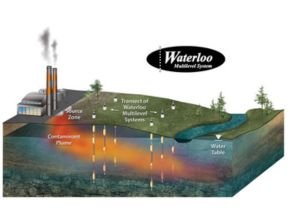
Description of Solinst Model 401 Waterloo Multilevel Systems
A single borehole may collect groundwater samples and data from numerous isolated zones thanks to the Waterloo Multilevel System. Users can tailor a system to any monitoring project thanks to its flexible design.
About Solinst Model 401 Waterloo Multilevel Systems
Groundwater samples, hydraulic head, and permeability readings are taken from numerous isolated zones within a single borehole using the Waterloo Multilevel Groundwater Monitoring System.
Because of its modular design, Waterloo Systems offers great site and application flexibility, enabling the precise positioning of ports and packers where they are required. Dedicated sampling and level monitoring capabilities, along with engineered seals, have been utilized up to 1000 feet (300 meters). The systems can be set up in boreholes that are 3 to 4 inches in diameter or bigger. There are options to fit overburden, bedrock, or a combination of both.
With fewer drilled holes, less site disruption, smaller purge volumes, and quicker sampling, Waterloo Systems lowers project costs and field time. At one site, several systems offer comprehensive 3-D groundwater data, facilitating better decision-making and more precise site and risk evaluations. It makes it possible to monitor natural attenuation, track and identify migratory contaminants, and assess remediation effectiveness.
Why Multilevels: Provide a Clearer Understanding of Subsurface Conditions
Monitoring a sequence of distinct isolated intervals at different depths in a single borehole yields data of superior quality. Accurate site assessments require the complete information that Multilevels provides in the form of horizontal and vertical flow together with discrete zone sampling for pollutants.
- Improve Site Assessments and Risk Management
1) Multilevels provide high resolution data for input into more representative ‘dynamic’ conceptual site models. 2) Transects of Multilevels across a groundwater flow path provide the best data to use for Mass Flux calculations. This has proven to be an important tool for site assessments that require realistic estimates of maximum contaminant concentration/risk to receptors. 3)Optimize performance of active remediation by using detailed 3-D data from a series of Multilevels. Subsequently, transects can be used to evaluate the success of the chosen remediation option and identify any areas requiring improvements. - The Economics Make Sense
Proven cost reductions for drilling and drilling waste.
Field personnel time and disposal costs are low, when purge volumes are reduced. The discrete interval that a Multilevel port encompasses allows for smaller purge volumes, rapid responses to level changes and is ideal for low flow sampling techniques.
Overcome Biases with Long Screened Wells
Contaminant mixing over long screens masks vertical variations resulting in underestimating the full extent of plumes and diluting the true concentration of contaminants.
Ambient vertical flow within the well has potential to transmit contaminants to non-contaminated zones.
Source: www.solinst.com
Read More:
- Bamo Ultrasonic flow meter BAMOFLONIC
- Emco Kimo KH 210-A-RF Temperature / Humidity / Current / Voltage / Impulse
- KIMO INSTRUMENT HD 50 Thermometer
- Zadetector KP826-B Pump Suction Type Multi-gas Detector
- Emco Kimo KTR 310-RF PT100 Temperature Data Logger