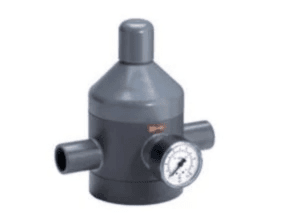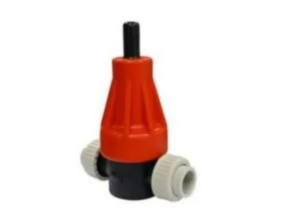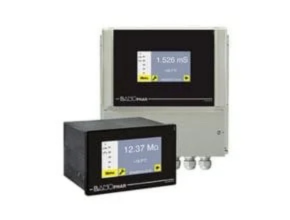
Discription Bamo SDD 911 Pressure Relief Valves ND 10 to ND 25 limits the static pressure to a constant and maximal settled value by opening the outlet (to the discharge line) when the pressure is overriding. An EPDM diaphragm, PTFE coated, separates the mechanical parts body and the channel. All wetted parts are in plastics. […]
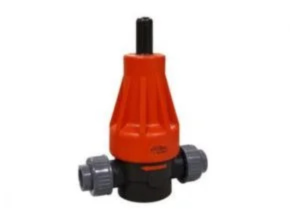
Description Bamo SDD 910 Pressure Relief Valves protects a network of pipes in the event of overpressure that could lead to deterioration of the system. It limits the static pressure to a constant upstream pressure when the pressure is over the settled value. All wet parts are of plastics. The diaphragm and seals are of […]
Description Bamo V182 -V82 Pressure Reducing Valves reduce in-line pressure at the outlet down to the pre-set value , to adjust on site. Outlet pressure is not directly proportional to inlet pressure. The choice of materials allows a large field of chemical in use. Versions with unions or flanges: on request. Bamo V182 -V82 Pressure […]
Description Bamo RDP 906 Pressure Reducing Valves maintains constant pressure downstream, at the adjusted value (lower than the upstream pressure). An EPDM diaphragm, PTFE coated, separates the mechanical parts body and the channel. All wetted parts are in plastics. The seat seal is in EPDM or FPM according to the model and connections. Without any […]
Description Bamo SPM 903 Valve Plastic Gauge Guards are suitable to protect sensors against the destroying effects of aggressive liquids. Their design, all in plastic, PTFE coated diaphragm, insure a high chemical resistance. Pressure from process is transferred to sensor through an incompressible liquid such as oil. Fitting of guard to sensor is done under […]
Descriptions Bamo BAMOPHAR 436 Turbidity Monitor is equipped with a color touch screen to set up the configuration and to display the turbidity, temperature and state of thresholds. Copies of measurement are available on 2 outputs 4-20 mA. BAMOPHAR 436 displays the turbidity value measured by one of our transmitters, to respond to process requirements. […]